
The kindergartner who'd been holding it together all morning finally lost it during cleanup — tears, a thrown crayon, the whole thing. Instead of sending him to the hall, his teacher walked him to the soft chair by the bookshelf, set the sand timer, and let him watch it fall. Three minutes later he wiped his face, checked the feelings chart, and rejoined the rug. Nobody made a scene. That spot did its job.
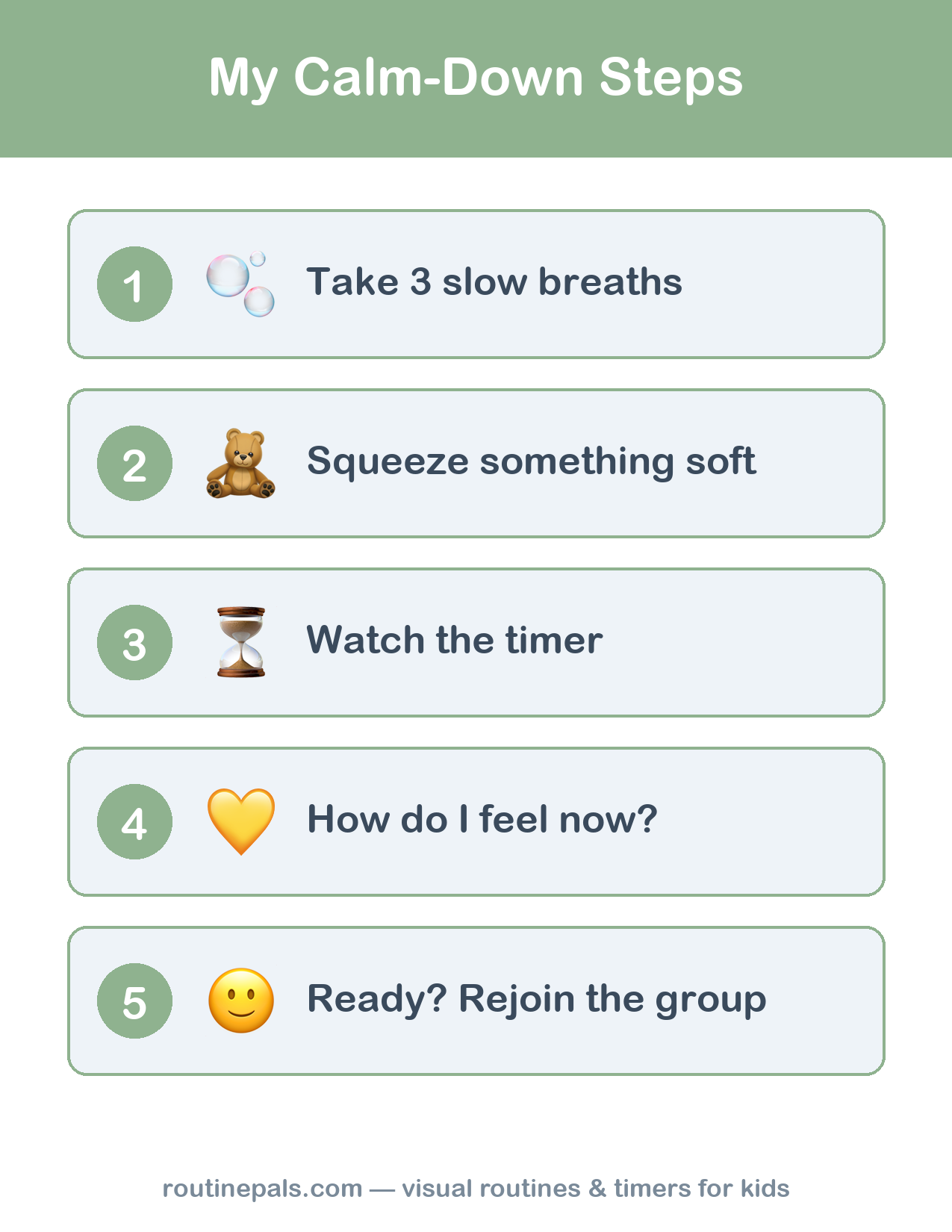
That spot is a calm-down corner, and when it's set up right it becomes one of the most reliable tools in the room. This guide walks through building one from scratch — where it goes, what goes in it, and the rules that keep it working past the first week. You'll also find a free printable "Calm-Down Corner Steps" poster below that you can laminate and post at kid eye level.
You can start with paper or printables first, then move the routine into RoutinePals when you want reusable, editable picture routines, calm visual timers, and a child-friendly runner view. Start free with one child; Pro adds more children.
Not a medical device or therapy. It is a practical structure tool for home and classroom routines.
What a calm-down corner actually is (and isn't)
A calm-down corner is a predictable spot where a child can go to regroup when feelings get big. It gives kids a place to slow their bodies down before they're ready to rejoin the group. That's it. The whole value sits in that word *predictable* — the child knows where it is, knows what to do there, and knows they'll come back.
Here's the part to nail down before you build anything: a calm corner in the classroom is not a timeout, and it is not a punishment. A timeout is something you assign — *go sit there because of what you did.* A calm-down area is something a child chooses, or that you gently offer, *so the child can feel better.* Same square of carpet, completely opposite message. The second you start sending kids there as a consequence, every kid in the room reclassifies it as the bad-kid spot, and the tool is dead. Protect that distinction from day one.
You'll hear this space called a lot of things — calming corner, cool down corner, quiet corner, peace corner. The label doesn't matter. The function does: a calm down space the child can use to settle, on their terms, with a clear way out.
Where to put it
Location makes or breaks a calming corner in the classroom. You want three things at once:
- Low-traffic. Not by the door, the pencil sharpener, or the line-up spot. A child trying to settle shouldn't have classmates stepping over them every ten seconds.
- Semi-private. A bookshelf turned perpendicular, a low divider, or a corner formed by two walls gives the child a sense of being tucked away. Full enclosure isn't the goal — a little visual buffer is.
- Visible to you. You need a clear sightline from wherever you usually stand or sit. Semi-private for the child, fully visible for the teacher. A back corner you can see from the carpet and your desk is ideal.
The classic setup is a carpet square or small rug in a back corner, framed by a bookshelf on one side. In a preschool calm down corner, keep it even more open — little ones get nervous when they can't see the teacher, so favor visibility over privacy.
What goes in it
Less is more, and this is where most corners go wrong. A calm-down corner is not a toy bin. The fastest way to wreck one is to fill it with so many interesting objects that kids ask to go there for fun. Keep it spare and purposeful:
- Soft seating — a beanbag, floor cushion, or a single small chair. One spot, one child.
- Two or three fidgets, max. A squishy ball, a stretchy band, one textured object. Not a basket of twelve.
- A feelings chart at the child's eye level so they can name what's going on.
- A breathing visual — a simple "smell the flower, blow out the candle" card or a finger-trace breathing star.
- A sand timer or visual timer so the child can *see* how long they're staying. This matters more than almost anything else in the corner.
- The posted steps — a short, picture-based sequence (the printable poster below covers this). Three or four steps, no paragraphs.
That's the whole kit. If you find yourself adding a fifth fidget or a stack of books, pull it back out.
What to put in it: a budget table
| Item | Budget option ($0–5) | Step-up option |
|---|---|---|
| Seating | Folded blanket or carpet square | Bean bag or floor cushion |
| Fidgets | Stress ball, hair tie, smooth stone | Tangle, stretchy band, textured cube |
| Timer | Dollar-store sand timer | Visual countdown timer or tablet |
| Feelings chart | Hand-drawn faces, laminated | Printed poster set |
| Breathing visual | Sharpie star on cardstock | Laminated breathing card deck |
| Privacy | Bookshelf you already own | Low fabric divider |
You can build a perfectly good calm down corner for under fifteen dollars. The expensive versions aren't more effective — they're just prettier.
The rules that make it work
A calm-down corner runs on a handful of rules that you set before any child ever uses it:
- Child-initiated when possible. The strongest version is the kid who notices their own big feelings and walks over on their own. Build toward that. Early on you'll offer it — "Looks like your body needs a break, want to use the calm corner?" — but the goal is self-direction.
- Time-limited with a visible timer. Flip the timer on arrival. When it's done, it's time to check in and rejoin. Without a visible timer, the corner becomes a place to hide from work, and you'll have a kid flipping the sand timer thirty times in a row.
- Taught before it's needed. You cannot introduce this tool in the middle of a meltdown. Teach it on a calm Tuesday morning when nobody's upset (more on this below).
- Never assigned as a consequence. Say it again to yourself. The moment it's a punishment, it stops being a calm-down corner.
- One child at a time. It's a solo regrouping spot, not a social area.
Teaching the corner
The corner only works if kids already know how to use it before the hard moment hits. Do practice runs when everyone is calm. Gather the class, walk them over, and model it yourself out loud: "My body feels frustrated. I'm going to sit here, flip the timer, take three breaths, point to how I feel, and go back to my seat." Then let kids take turns practicing the steps with no real upset attached.
Run these practice sessions a few times the first week, then revisit whenever a new child joins or the routine gets sloppy. Kids who've rehearsed the steps when calm can actually find them when they're flooded. Kids who haven't will just stand in the corner looking lost.
Preschool vs. elementary
The bones are the same; the details shift with age.
In preschool, keep everything more visible and more guided. Three- and four-year-olds usually need you to walk them over and stay nearby. Use a sand timer they can watch rather than a digital countdown, lean hard on the feelings faces, and expect to co-regulate beside them more often than not. A preschool calm down corner is something you do *with* the child as much as a place you send them.
In elementary, you're coaching toward independence. Older kids can read a posted step list, set their own visual timer, and self-initiate. Give them more privacy and more ownership. By second or third grade, many students will use a quiet corner classroom spot entirely on their own, which is exactly the point.
The home version
Families ask about this constantly, and the answer is yes — a calm down area works just as well in a bedroom corner. Same recipe, smaller scale: a cushion or the corner of the bed, one or two fidgets, a feelings chart taped to the wall, a timer, and the same steps posted nearby. The home version helps the most when it matches the classroom version, so the child meets the same routine in both places.
Common mistakes
Three drifts kill more calm-down corners than anything else:
- Toy-bin drift. Stuff accumulates until the corner is the most fun place in the room and kids angle to go there. Audit it monthly and strip it back to essentials.
- Punishment drift. A frustrated adult starts using it as a consequence. Once that happens, kids resist it and the tool is gone. Guard the line constantly.
- No exit routine. Kids go in and just... stay. Without a clear way out, the corner becomes an escape hatch from the work of rejoining.
The exit routine
Every trip to the corner needs a defined ending, or it doesn't end. Keep it to three beats:
1. Timer ends. The visible timer runs out — that's the cue, not your nagging. 2. Feelings check. The child points to the feelings chart: how's my body now? 3. Rejoin. They return to the group and slide back into whatever's happening.
Teach the exit routine as carefully as you teach the entry. The point of a calm corner classroom tool isn't to leave the group — it's to come back ready.
Where RoutinePals fits
If you'd rather not juggle a sand timer, a feelings chart, and a printed step list, a tablet stationed in the corner can hold all three. RoutinePals runs a calm visual timer for corner time and a feelings check-in routine the child taps through on their way out — the same exit routine, on a screen. It's one option, not a requirement; the cardstock-and-sand-timer version works beautifully too.
If you're building out timers and step lists across the room, our visual timer classroom guide and visual schedules guide cover the broader setup.
Try RoutinePals free
If one student needs the structure to travel with them — corner time at school, the same steps at home — RoutinePals keeps the visual timer and feelings check-in consistent across both. There's a free plan, and Pro is $6.99/mo or $49.99/yr. It runs on the web, iPhone, and Android, so the corner routine looks the same wherever the child meets it.
Frequently asked questions
Is a calm-down corner the same as a timeout?
No, and keeping them separate is the whole point. A timeout is assigned by an adult as a consequence. A calm-down corner is a place a child chooses, or is gently offered, so they can settle their body and rejoin the group. The moment you start sending kids there as punishment, the class reclassifies it as the bad-kid spot and it stops working.
What age is a calm-down corner appropriate for?
It works from preschool through upper elementary. Younger children need more guidance — you'll often walk them over and stay nearby — while older students can self-initiate, set their own timer, and follow a posted step list independently. Same tool, more independence with age.
How long should a child stay in the calm-down corner?
Use a visible timer rather than a set rule in your head. A few minutes is typical. The visible timer matters more than the exact length, because it shows the child the break is finite and signals when it's time to do the feelings check and rejoin.
What should I NOT put in a calm-down corner?
Skip the toy bin. More than two or three fidgets turns the corner into the most fun place in the room, and kids will angle to go there for play instead of regrouping. Keep it spare: soft seating, a couple of fidgets, a feelings chart, a breathing visual, a timer, and the posted steps.
Free: 1 child, 3 editable template or custom routines, and 3 characters. No time limit, no card needed.
Pro adds more children, unlimited routines, and ongoing AI creation: $6.99/mo or $49.99/yr. Web monthly starts at $2.99 for the first month, then $6.99/mo. Eligible iOS and Android subscribers can receive a 7-day trial; check your store offer.
Choose your first free routine