Bedtime is the hardest transition of the day, and it is not close. By the time the sun goes down, everyone is running on fumes. The kid is tired but wired, you are tired and done, and the gap between "go get ready for bed" and an actually-asleep child is where a lot of families lose an hour every single night. The lights-out standoff is a nightly institution in more homes than anyone admits.
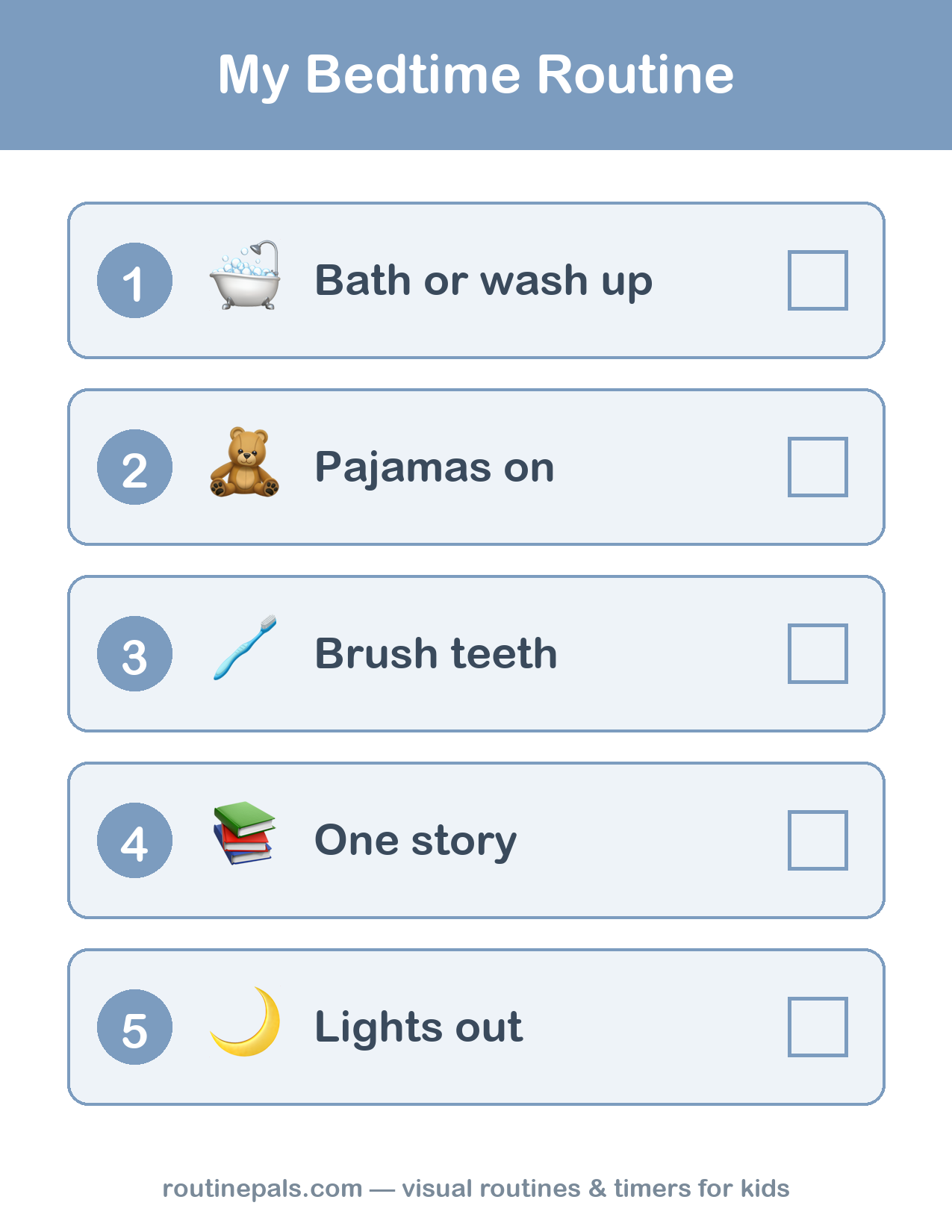
A bedtime routine chart will not make a kid sleepy. What it does is take the nightly negotiation off your plate and hand the sequence to the child. Instead of you narrating every step, the chart does the reminding, and the kid does the doing. The printable below gives you a ready-made version you can tape to the bathroom mirror tonight, so let's talk about what makes one actually work.
What makes a chart work
Most bedtime charts fail for the same reasons, and they are all fixable.
Four to six steps, max. This is the one rule that matters most. A bedtime chart with eleven items is a chore list, and no exhausted six-year-old is reading a chore list at 8 p.m. Bundle small things together. "Get ready for bed" can quietly contain three sub-tasks; on the chart, it is one picture.
Pictures, not just words. Even kids who can read are running low on processing power at bedtime, and a picture is faster to grasp than a sentence. A photo of *their* toothbrush or *their* pajama drawer beats a generic cartoon. For pre-readers, pictures are the whole game.
Same order, every single night. The power of the chart is predictability. Bath, pajamas, teeth, story, lights out, in that order, tonight and tomorrow and the night after. When the order is fixed, the kid stops asking what's next because they already know, and the routine starts running on autopilot.
The kid checks it off, not you. This is the part parents accidentally steal. The whole point is to transfer ownership. When the child moves the marker, flips the card, or taps the step as done, they are running their own bedtime. When you do it for them, it is just you managing them with extra steps. Hand over the checking-off and resist the urge to take it back.
A sample five-step bedtime sequence
Here is a sequence that works for a lot of families. Adjust the specifics, keep the shape.
| Step | Picture | What it covers |
|---|---|---|
| 1 | Bath / wash up | Bath or a quick wash, depending on the night |
| 2 | Pajamas on | Including putting dirty clothes in the hamper |
| 3 | Brush teeth | At the sink, with the toothbrush in view |
| 4 | One story | Picked before brushing, so there's no stall-shopping |
| 5 | Lights out | Into bed, lamp off, done |
Five steps, same order, each one a picture the kid checks off as they go. Notice that picking the story happens *before* the story step, which heads off the classic "but I want a different book" delay tactic at the door.
Why charts stop working, and how to fix it
Too many steps
If the chart isn't getting used, count the steps. More than six and you have probably built a checklist nobody wants to read. Trim it. Combine the small stuff. A shorter chart that gets followed beats a thorough chart that gets ignored.
The chart became a punishment
The fastest way to kill a bedtime chart is to weaponize it. "You didn't finish your chart, so no story tomorrow." The moment the chart is tied to consequences, it stops being a friendly map and becomes one more thing to fight about. Keep it neutral. The chart shows the way; it does not hand out penalties.
The novelty wore off
This one is real and it catches everyone. A new chart is exciting for about a week, and then it becomes wallpaper the kid stops seeing. The fix is rotation. Swap the artwork, change the reward sticker style, let the kid re-pick the photos, or move to a fresh chart design every few weeks. You are not changing the routine, just refreshing the look enough to make it visible again. This is one area where a digital version has a real edge, since rotating the look takes seconds instead of a trip to the printer.
Printable or app?
We offer both, on purpose, because both have their place.
The printable below is free, works the second you tape it up, and needs no battery, no login, and no screen near a kid who is supposed to be winding down. For a lot of families, paper on the bathroom mirror is exactly right.
The app version solves the problems paper can't. With RoutinePals, the kid taps each step as they finish it, calm visual timers help with the "five more minutes" moments, and 40 illustrated templates mean you can rotate the look the instant the novelty wears off. There's a parent dashboard and a kid PIN login, so the child runs their own bedtime while you keep an eye on how it's going.
If you want to see how the digital approach works across the whole day, not just bedtime, take a look at our visual schedule app guide. RoutinePals runs on the web and iOS, with a free plan and Pro at $6.99/mo or $49.99/yr.
Grab the printable below to start tonight, and switch to the app whenever you want the timers and the easy rotation. Either way, the goal is the same: hand bedtime back to the kid, keep it short, keep it predictable.
Frequently asked questions
How many steps should a bedtime routine chart have?
Four to six, maximum. A tired child will not work through a long checklist at the end of the day. Bundle small tasks together so the chart stays short, and break the night into a handful of clear, picture-based steps the kid can actually follow.
Should the parent or the child check off the steps?
The child. The entire point of a bedtime chart is to hand ownership of the routine to the kid. When they move the marker or tap the step as done, they are running their own bedtime. When the parent does it, the chart is just adult management with extra steps.
My child's chart stopped working after a week. What happened?
The novelty wore off, which happens to almost every chart. The fix is rotation: swap the artwork, change the stickers, let the child re-pick the photos, or move to a fresh design every few weeks. You keep the routine identical and just refresh the look so the chart becomes visible again.
Is a printable chart or an app better for bedtime?
Both work. A printable is free, instant, and keeps screens away from a winding-down child. An app like RoutinePals adds tap-to-check steps, calm visual timers, and easy rotation through 40 templates when the novelty fades. Many families use paper at the sink and the app for the broader routine.
Free: 1 child, 3 editable template or custom routines, and 3 characters. No time limit, no card needed.
Pro adds more children, unlimited routines, and ongoing AI creation: $6.99/mo or $49.99/yr. Web monthly starts at $2.99 for the first month, then $6.99/mo. Eligible iOS and Android subscribers can receive a 7-day trial; check your store offer.
Choose your first free routine