
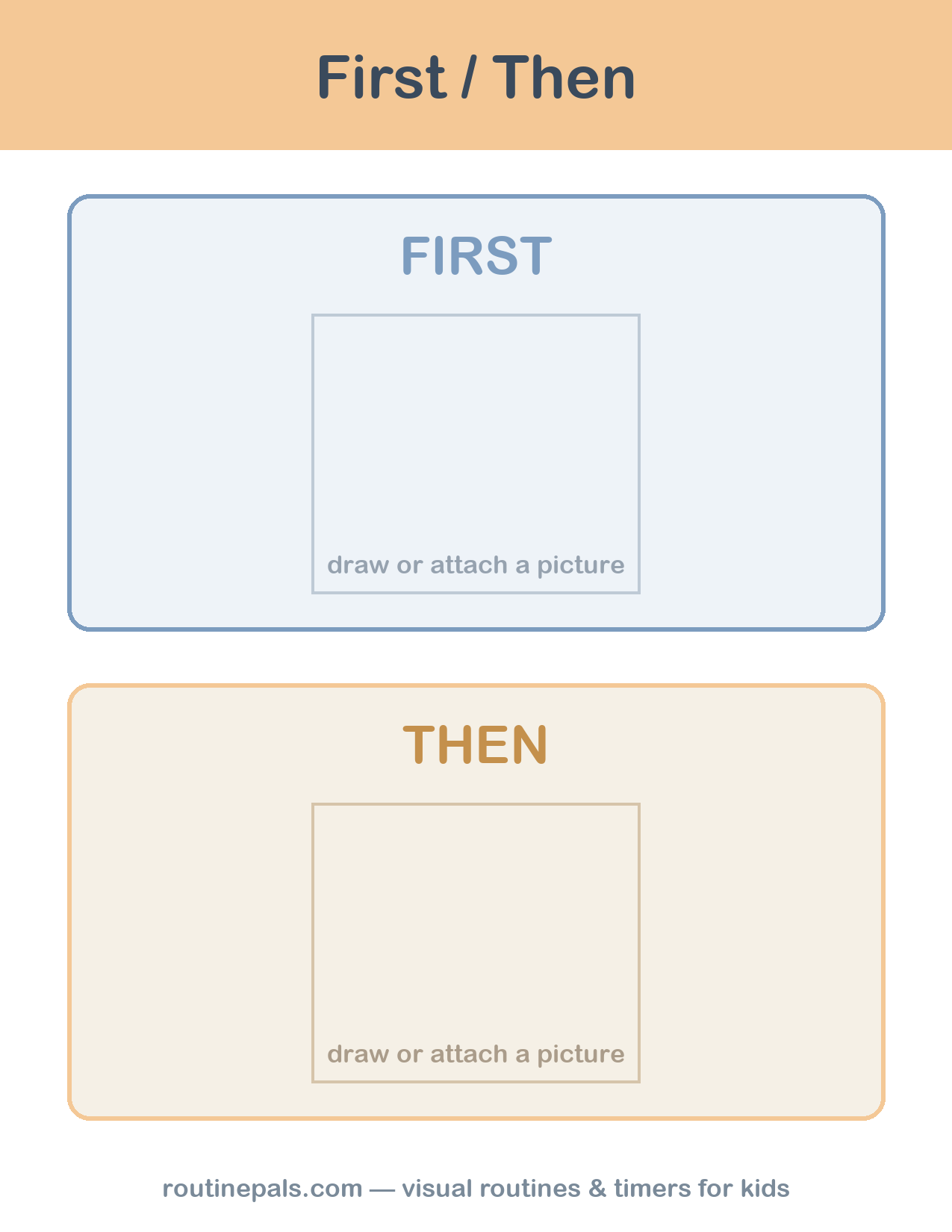
It's bath time and your three-year-old has planted himself under the kitchen table like he's filing a formal protest. You could negotiate. You could carry him. Instead you set a small board on the floor: on the left, a picture of the bathtub; on the right, his favorite bedtime book. "First bath, then book." He stares at it, weighs his options, and crawls out. No tears, no lecture. The board did the talking.
That's the entire appeal of a first/then board. It is the simplest visual support there is, and you can grab one from the printables below and start using it today.
What a first/then board is
A first/then board has exactly two slots. The left side shows what has to happen first. The right side shows the preferred thing that comes after.
*First [task], then [preferred thing].*
First shoes, then park. First clean up, then snack. First two math problems, then a break. The structure is deliberately tiny. It strips a moment down to one expectation and one payoff, which is exactly what a stuck or overwhelmed child can handle when a longer list would tip them over.
When a first/then board shines
- Transitions. Moving from a fun thing to a not-fun thing is where most resistance lives. The board makes the next preferred thing visible, so the child isn't just losing something, they're heading toward something.
- New or non-preferred tasks. When you're asking for something a child would rather skip, pairing it with a clear "then" gives them a reason to start.
- Building toward longer schedules. A first/then is the training-wheels version of a full visual routine. Master two steps, and three steps stop feeling impossible.
First/then boards are especially common in autism support settings — teachers and therapists often reach for one as the very first visual support an autistic child uses, exactly because two steps is a manageable starting point. The same board works the same way at home.
How to use one well
One clear picture per side. Resist the urge to crowd the board. A single, obvious image on each side keeps the message clean. A child in a hard moment can't parse clutter.
The "then" has to actually happen. This is the rule that makes or breaks the tool. If you promise "then iPad" and the iPad doesn't come, the board stops meaning anything by next week. Only put a "then" on the board that you can and will deliver.
Keep your tone neutral. Present the board as information, not as a deal you're winning. "First bath, then book," said evenly, lands very differently from a sing-song bribe or a clenched-teeth ultimatum. The board is a map, not a threat.
Fade toward fuller schedules. Once two steps are easy, add a third. A first/then naturally grows into a first-next-then strip, then into a full picture routine. The board isn't the destination; it's the on-ramp.
Laminating and velcro tips for the printable
Print the board, then laminate it so it survives sticky hands and the occasional under-table standoff. Add a strip of self-adhesive velcro (the hook side) to each slot.
Print a second sheet of small task and reward pictures, laminate those, and stick the soft velcro (the loop side) on their backs. Now you've got a reusable board: swap in *first shoes / then park* this morning and *first teeth / then story* tonight. Keep the loose pictures in a zip bag or a small bin so they don't wander. Laminated boards also wipe clean if you'd rather write on them with a dry-erase marker instead of using velcro pictures.
Common mistakes to avoid
Using it as a threat. "First you behave, then maybe you get dessert" weaponizes the board. It's meant to be a calm, neutral picture of what's next, not leverage in an argument.
Stacking multiple firsts. "First clean up, first wash hands, first sit down, then snack" defeats the whole point. If you've got several steps, you've outgrown the first/then, that's your cue to move to a short visual schedule, not to cram the board.
Vague pictures. A generic "work" icon doesn't tell a child what they actually have to do. Be specific: the exact worksheet, the actual tub, the real reward.
Where RoutinePals comes in
A first/then board is the two-step version of a picture routine. Once a child handles two steps reliably, they're usually ready for more, and that's the gap RoutinePals fills. The app does the multi-step version: picture-step routines with a calm visual timer on each step, a parent dashboard, and a simple kid PIN login. Forty illustrated templates cover mornings, bedtime, hygiene, chores, and more, so the leap from a paper first/then to a full routine doesn't mean starting from scratch. Our visual schedules guide walks through that progression. RoutinePals is a visual support, the kind families, teachers, and occupational therapists already use, not a medical device or treatment.
Try RoutinePals free
When two steps turn into five, RoutinePals carries the same calm structure into a full picture routine with a built-in timer on every step, on web, iPhone and Android. There's a free plan, and Pro is $6.99/mo or $49.99/yr. Grab a printable first/then above to start today, and move up to a full routine whenever your child is ready.
Frequently asked questions
What is a first/then board?
It's the simplest visual support there is: a two-slot board showing what happens first (a task) and then (a preferred thing). 'First bath, then book.' It strips a moment down to one expectation and one reward, which is manageable for a child who'd be overwhelmed by a longer list.
How do I use a first/then board without it becoming a bribe or threat?
Keep your tone neutral and treat the board as information, not leverage. Use one clear picture per side, and make sure the 'then' actually happens every time, otherwise the board loses meaning. It's a map of what's next, not a deal you're winning or an ultimatum.
How do I make the printable reusable?
Laminate the board so it survives daily use, then add hook velcro to each slot. Print and laminate small task and reward pictures with loop velcro on the back, and swap them in and out. You can also write on a laminated board with a dry-erase marker instead.
When should I move beyond a first/then board?
Once a child handles two steps reliably, add a third and let it grow into a short visual schedule. If you find yourself stacking multiple 'firsts,' that's the signal to move up to a full picture routine rather than crowding the board.
Free: 1 child, 3 editable template or custom routines, and 3 characters. No time limit, no card needed.
Pro adds more children, unlimited routines, and ongoing AI creation: $6.99/mo or $49.99/yr. Web monthly starts at $2.99 for the first month, then $6.99/mo. Eligible iOS and Android subscribers can receive a 7-day trial; check your store offer.
Choose your first free routine