
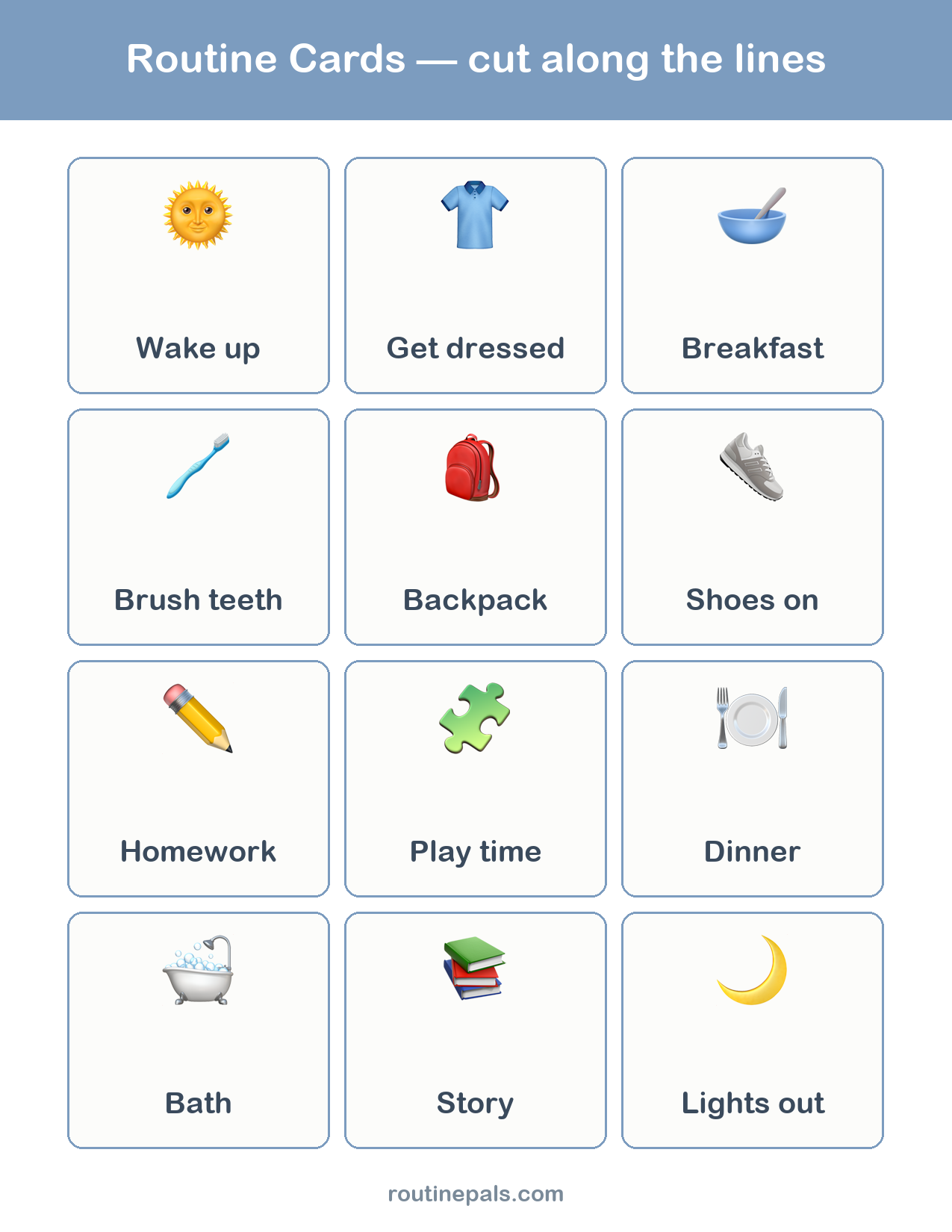
Tuesday is library day, Wednesday is early release, and Thursday somebody has a dentist appointment at 10. A printed wall chart can't keep up with a week like that — but a deck of cards you rearrange each morning can. That's the quiet advantage of routine cards: one set of pictures, endless schedules.
This page hosts free printable routine card sheets — grab the printables below, print them on cardstock, and you've got a working deck in about ten minutes.
What routine cards are
Routine cards are individual picture cards, each showing one step — *brush teeth*, *put on shoes*, *pack backpack* — that you arrange into whatever sequence the day calls for. Think of them as the LEGO bricks of visual schedules. A fixed picture daily schedule on the wall is one finished build; routine cards are the loose bricks you can snap together into a morning routine, a bedtime routine, or a school-day sequence, then take apart and rebuild tomorrow.
That flexibility is the whole point. A child who freezes at "get ready" can follow *socks → shoes → coat → backpack* laid out one card at a time. And because each step is its own card, you build any picture routine from the same deck instead of buying a new chart for every situation.
How to use them
The cards do nothing sitting in a pile — they need a surface. Three setups cover almost everyone:
- Velcro strip. Stick the loop side along a strip of poster board and the hook side on the back of each card. Kids pull a card off as they finish each step, which gives a satisfying *done* moment. This is the workhorse for a daily picture schedule at home or in the classroom.
- Magnetic board. Glue thin magnets to the card backs and arrange them on the fridge or a magnetic whiteboard. Easy to reshuffle, easy for little hands to move.
- Ring clip. Punch a hole in the corner of each card and thread the day's steps onto a binder ring. Now the strip is portable — clip it to a backpack for a school sequence or a diaper bag for outings.
Most families end up with a master set in one spot and a small portable ring for trips.
Building sequences from one deck
The same deck builds your whole day. Pull the cards you need and line them up:
- Morning: wake up → bathroom → get dressed → breakfast → teeth → shoes → backpack
- Bedtime: bath → pajamas → teeth → story → lights out
- School: unpack → morning work → carpet → centers → lunch
Notice *teeth* and *get dressed* show up in more than one sequence — that's the efficiency. You're not making three separate charts. You're drawing from one set of daily schedule cards and arranging them fresh for each part of the day.
Photo vs. icon cards
Which card style works better depends on the child.
Photo cards show the real thing — your actual bathroom sink, your child's own backpack. For younger kids, kids who are concrete thinkers, or anyone just starting with visual schedules, photos transfer more directly to real life. The trade-off is they take effort to make, and they're tied to your specific stuff.
Icon cards use simple illustrations. They're cleaner, instantly reusable across kids and settings, and they generalize better once a child understands that a drawing stands for the real thing. The printables below are icon-based for exactly that reason — print once, use anywhere.
Many families start with photos for the trickiest steps and use icons for everything else.
Laminating tips
Cards live in sticky, wet, get-dropped-on hands, so protect them:
- Cardstock first, then laminate — flimsy paper curls and tears even laminated.
- Round the corners with scissors or a corner punch. Sharp laminate corners peel and poke.
- Leave a small border of laminate around each card so the seal doesn't split.
- If you're using velcro, stick it on after laminating, not before.
Laminated, rounded, cardstock-backed cards survive a full school year of handling.
When cards win, and when a fixed chart wins
Routine cards aren't always the right call. Match the tool to the routine:
Cards win when the routine changes. Different schedule every day, a week full of appointments and special events, a child who needs *today's* plan and not the generic one — that's card territory. You rebuild in seconds.
A fixed chart wins when the routine is stable. If bedtime is the same five steps every single night, a permanent bedtime chart on the wall means nobody has to set it up. Predictable routines reward a fixed picture daily schedule; variable ones reward a deck. Plenty of homes use both — a fixed bedtime chart and a flexible card deck for everything else.
The digital deck: RoutinePals
If the laminating and velcro feel like a lot, RoutinePals is the same idea on a screen. It's a digital deck of 40 illustrated routine templates — morning, bedtime, hygiene, school, chores, feelings check-ins, outings — that you rearrange in seconds instead of re-velcroing cards. Each step carries a built-in visual timer, so there's no separate sand timer to manage, and the deck never gets dropped under the couch.
It's not a replacement for paper if paper's working for you — some kids do better with cards they can physically pull off a strip. But for routines that shift daily, tapping to reorder beats reprinting. See how it compares in our visual schedule app guide, and grab the related first/then board and bedtime chart printables while you're here.
Try RoutinePals free
When you're tired of reprinting cards every time the week shifts, RoutinePals holds the whole deck digitally — 40 illustrated templates, rearrange in seconds, timers on every step. There's a free plan, and Pro is $6.99/mo or $49.99/yr, and it runs on the web, iPhone, and Android. Print the cards below to start today, and switch to the digital deck whenever the paper gets old.
Frequently asked questions
What's the difference between routine cards and a picture schedule chart?
Routine cards are individual picture cards you arrange into any sequence — the loose bricks. A picture schedule chart is one fixed, finished build. Cards shine when the daily routine changes; a fixed chart shines when the same steps repeat every day, like a stable bedtime. Many families use both.
Should I use photo cards or icon cards?
Photos show the real object and transfer directly to real life, which helps younger or very concrete-thinking kids — but they take effort to make. Icon cards are cleaner, instantly reusable across kids and settings, and generalize well. The free printables here are icon-based so you can print once and use anywhere.
How do I make routine cards last?
Print on cardstock, then laminate — flimsy paper curls even laminated. Round the corners so the laminate doesn't peel or poke, and leave a small border around each card so the seal holds. If you're using velcro, attach it after laminating.
Can I build different routines from the same set of cards?
Yes — that's the main advantage. One deck builds morning, bedtime, and school sequences because steps like 'brush teeth' and 'get dressed' reuse across them. You pull the cards you need, line them up for that part of the day, and rebuild whenever the schedule shifts.
Free: 1 child, 3 editable template or custom routines, and 3 characters. No time limit, no card needed.
Pro adds more children, unlimited routines, and ongoing AI creation: $6.99/mo or $49.99/yr. Web monthly starts at $2.99 for the first month, then $6.99/mo. Eligible iOS and Android subscribers can receive a 7-day trial; check your store offer.
Choose your first free routine